


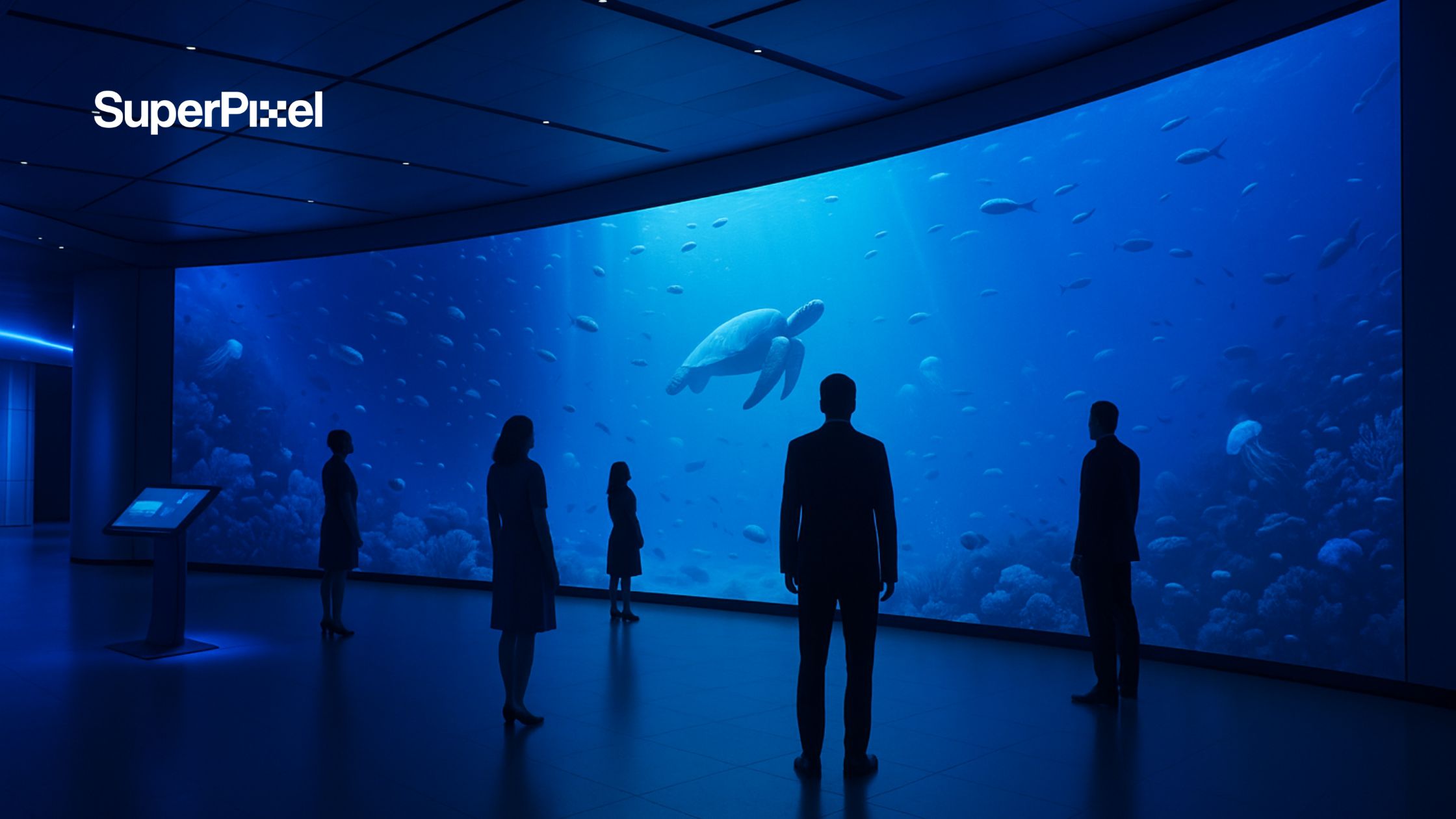
I remember standing in our Jakarta studio, reviewing the initial concepts for a massive LED screen at the Pacific Place mall. The client wanted to boost foot traffic, but we knew another flashy digital ad wasn’t the answer.
People are tired of being sold to. We pitched something different: an immersive underwater world that didn’t just advertise, but created a sense of wonder. That project taught me a critical lesson: in a world saturated with digital noise, the brands that win are the ones that create memorable moments.
They don’t just push a message; they design an experience. It inspired us to explore new ways to engage audiences beyond traditional advertising, opening up possibilities for truly immersive and meaningful brand interactions.

Key Takeaways:
- Experiential design is more than just aesthetics; it’s about creating emotional, sensory journeys that build deep brand connections.
- In 2025, with shrinking attention spans, immersive and interactive elements are no longer a “nice-to-have” but a core part of a relevant brand strategy.
- The impact of experiential design is highly measurable, directly linking creative concepts to KPIs like engagement, foot traffic, and brand loyalty.
- Successful implementation requires a strategic framework that aligns experience goals with the core brand mission from day one.
- The future is “phygital”—a blend of physical and digital environments—and leaders who delay investing in this space risk becoming irrelevant.
What Experiential Design Really Means in Business
Running studios across three countries has taught me that the principles of great storytelling are universal, but how you deliver that story has to evolve. Experiential design is the art and science of putting your audience inside the story.
It’s not just about making a space look good; it’s about crafting a journey. Think of it this way: instead of telling someone your brand is innovative, you create an interactive installation that lets them feel that innovation firsthand.
At its core, this design practice is built on a few key principles: storytelling, immersion, interactivity, and emotional triggers. It’s about creating multi-sensory physical environments where every one of the elements, from the lighting and graphic design to the interactive screens, works together to support a central brand message.
This is where you move from passive viewing to active participation. An article from Emerald Publishing (2012) on experiential learning reinforces this idea, noting that people learn and remember more effectively through direct experience and reflection. For sure, when a person can interact with a concept, the message sticks.
This shift is crucial in 2025. Audience fatigue is real. A recent report from Retail Insider (2024) highlights that modern consumers are seeking meaningful experiences over just products. They want to engage with a brand, not just buy from it.
This form of design isn’t just a creative exercise, eh; it’s a direct response to this fundamental change in consumer behaviour. It’s becoming the new baseline for brand relevance. Creating an immersive experience is key to capturing attention and fostering deeper connections that last beyond the moment.
How Experiential Design Drives Measurable Results
Now, I’ll be honest with you. For a long time, creative projects like these were seen as “fluff” great for the brand portfolio, but hard to connect to the bottom line.
That’s just not the case anymore. The breakthrough moment came when we started treating experiential design like performance marketing. Every creative choice can and should be tied to a key performance indicator.
When we developed the Pacific Place Aquarium project, the goal was clear: increase foot traffic and how long people stayed at the mall. The solution was a massive, immersive 3D experience that transformed a simple built environment into a destination.
The result? A 30% increase in foot traffic and a 45% longer average visit. That’s not fluff; that’s a tangible business impact driven by a creative concept. This is where most people get it wrong—they see the art but miss the science behind it.
A Forrester (2019) analysis supports this, showing that mature design thinking practices can generate a median per-project ROI of 229%.
The technology we have today is a massive growth multiplier. Augmented reality (AR), virtual reality (VR), and large-scale interactive installations allow us to create incredibly deep and engaging environments. We saw this with the Singapore City Gallery Interactive Experience.
The challenge was to make complex urban planning engaging for the public. By creating an interactive 3D exploration platform, we turned a potentially dry subject into an exciting journey, leading to an 85% increase in visitor engagement time.
This is what it looks like in practice: technology used not for its own sake, but to serve a story and achieve a specific business goal.
A Leader’s Framework for Implementing Experiential Design
So, where do you start? The process matters just as much as the final execution. Right off the bat, I should mention that jumping in without a clear strategy is the quickest way to waste a budget. You need a framework.
First, align your experience goals with your core brand mission. What is the one feeling or message you want a person to walk away with? Define your success metrics from the very beginning. Is it dwell time, social media shares, lead generation, or something else? Knowing this will shape every design decision you make.
From my experience, one of the most common pitfalls is focusing too much on aesthetics. A space can be visually appealing, but if it doesn’t tell a story or encourage users to interact in a meaningful way, it’s just decoration. Another major issue is ignoring cultural context.
Building teams in Vancouver versus Singapore taught me that what captivates one audience might fall flat with another. Your design must be rooted in a deep understanding of the people who will interact with it.
Whether you are working on exhibition design, themed environments, or interactive installations, partnering with the right creative studio and experienced experiential designers is critical. Look for a team with a diverse portfolio that shows they can deliver across different industries and scale their ideas.
They should be able to talk about ROI as fluently as they talk about graphic design or spatial design. The pattern I see across successful projects is a tight, collaborative relationship built on shared goals and a clear process.
The Future of Experiential Design and Why Leaders Can’t Wait
Looking ahead, the future of experiential design is undeniably hybrid, or “phygital” the seamless integration of physical and digital elements. Think of retail spaces that use AR to let customers “try on” products or corporate training that blends VR simulations with in-person workshops.
The line between the physical and digital world is blurring, and the most successful brands will be those that create compelling experiences in that blended reality.
This trend is accelerating across all industries. We’re seeing it in museums creating interactive exhibitions, in healthcare using immersive environments to reduce patient anxiety, and of course, in global advertising campaigns. Leaders who see this as a passing trend are making a mistake.
Competitors are already embedding this design practice into their core branding strategies because they see the results. It’s becoming a key part of education, and you even see students now pursuing an experiential design degree to learn these holistic approaches.
From working on projects for brands like TikTok and Mandai Wildlife Reserve, I’ve learned that audiences now expect more. They crave connection, interaction, and a story they can be part of. The brands that fail to deliver these engaging experiences will struggle to capture attention and build loyalty.
The time to act is now. The future belongs to the leaders who don’t just sell a product, but create a world their customers want to join.
Frequently Asked Questions
What’s the difference between experiential and experiential interior design?
Experiential interior design focuses on crafting the narrative and emotional journey within the walls of a physical space. Broader experiential design can include that, but also covers temporary pop-ups, digital AR/VR environments, and interactive installations that might not be tied to a traditional interior at all.
How do you measure the ROI of an experiential design project?
We tie everything to predefined business goals. Metrics can include foot traffic increase, dwell time, social media engagement rates, lead generation, and user participation rates. For our Pacific Place Aquarium project, we measured a 30% increase in foot traffic, a clear and direct return you can evaluate.
Where should a business start with its first experiential design project?
Start with your ‘why.’ What business challenge are you trying to solve, and what is the core message you want to communicate? A small, focused project like an interactive pop-up or an AR feature for an existing retail store is a great way to test new ideas and measure impact before scaling up.
You might also like: Unlock the Power of Advertising Animation for Business Growth